Managing Technical Dependencies in Hardware Teams: SAFe, Systems Thinking & Universal Blockers
Disclaimer
This article provides insight into hardware and firmware teams, exploring how Agile methodologies can be adapted for such environments in contrast to frameworks widely accepted in the software world. This analysis is based on comprehensive industry research, academic articles, and technical reports, all of which are referenced at the end of the text. These findings are combined with my personal structured analysis and learnings to present a cohesive overview of the concept as a whole.
⚙️ Motivation
Coming from an automotive environment, I have worked in mixed cadences of software and firmware, with lots of dependencies on hardware. However, I have always wanted to take a deep dive into the actual workings of pure hardware-based teams and investigate how Lean-Agile methodologies could be applied to such teams, compared to a traditional Waterfall practice. For a project management practitioner, it is critical to learn and anticipate the technical blockers that could exist in such teams, so that cross-team dependencies between teams can be effectively clarified.
Industries considered are focused on the embedded systems and semiconductor landscape:
- Semiconductors and Foundries: High-Performance Computing, advanced sub-node Fab processing, Automated Test Equipment (ATEs) etc.
- Automotive Technologies: Safety-critical ECUs, ADAS Radar etc.
- Other embedded sectors: Health Tech, Aerospace/Avionics etc.
〽️ Moore’s Law
An important law that holds true, especially for hardware-focused industries, is Moore’s Law.
Moore’s Law states that the number of transistors on a microchip doubles roughly every two years, while the cost of computers is halved.
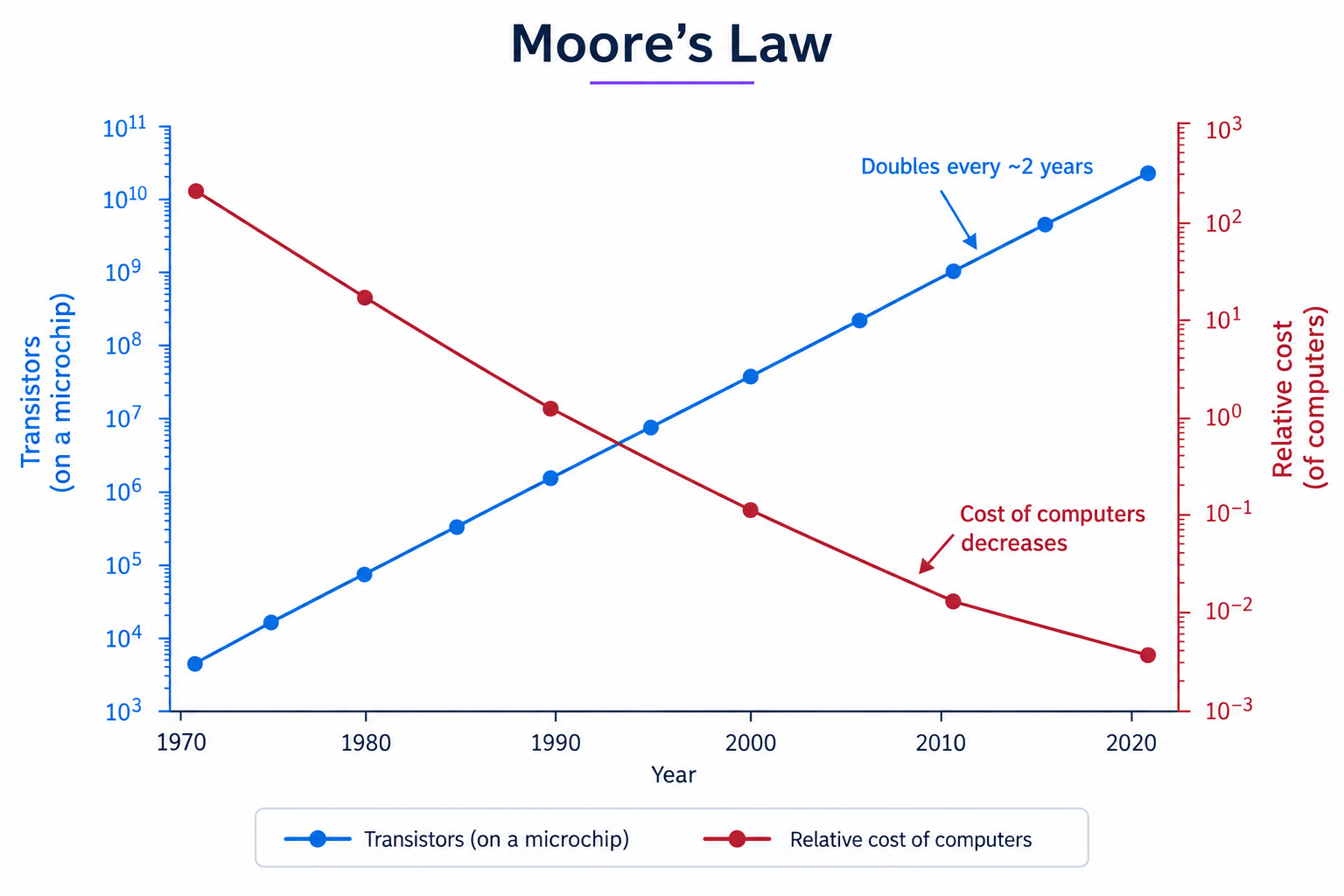
Moore’s Law presents specific challenges to project management. These are:
- A project may become obsolete before it's even completed. As computer power rises and infrastructure costs fall, technology is no longer static. This means a traditional, long-standing and rigid Waterfall project may become obsolete by the time it is ready for delivery.
- Feature creep: With these computing capacities, it is possible to include heavy new features in a hardware project, which could alter the scope mid-project.
- ‘Wait to Buy’ Dilemma: Hardware procurement done too late risks stalling the development teams. At the same time, buying the hardware too early could mean that a higher price is paid for the technology, which could possibly be cheaper closer to launch. Also, locking in on a hardware vendor could be risky if the vendor is not able to keep pace with technology advancements.
🔍 How the Agile methodology could help mitigate these challenges
The traditional project management approach fixes the scope as part of the Iron Triangle. In contrast, Agile flips this triangle to keep time, cost, and quality fixed, but scope is kept negotiable.
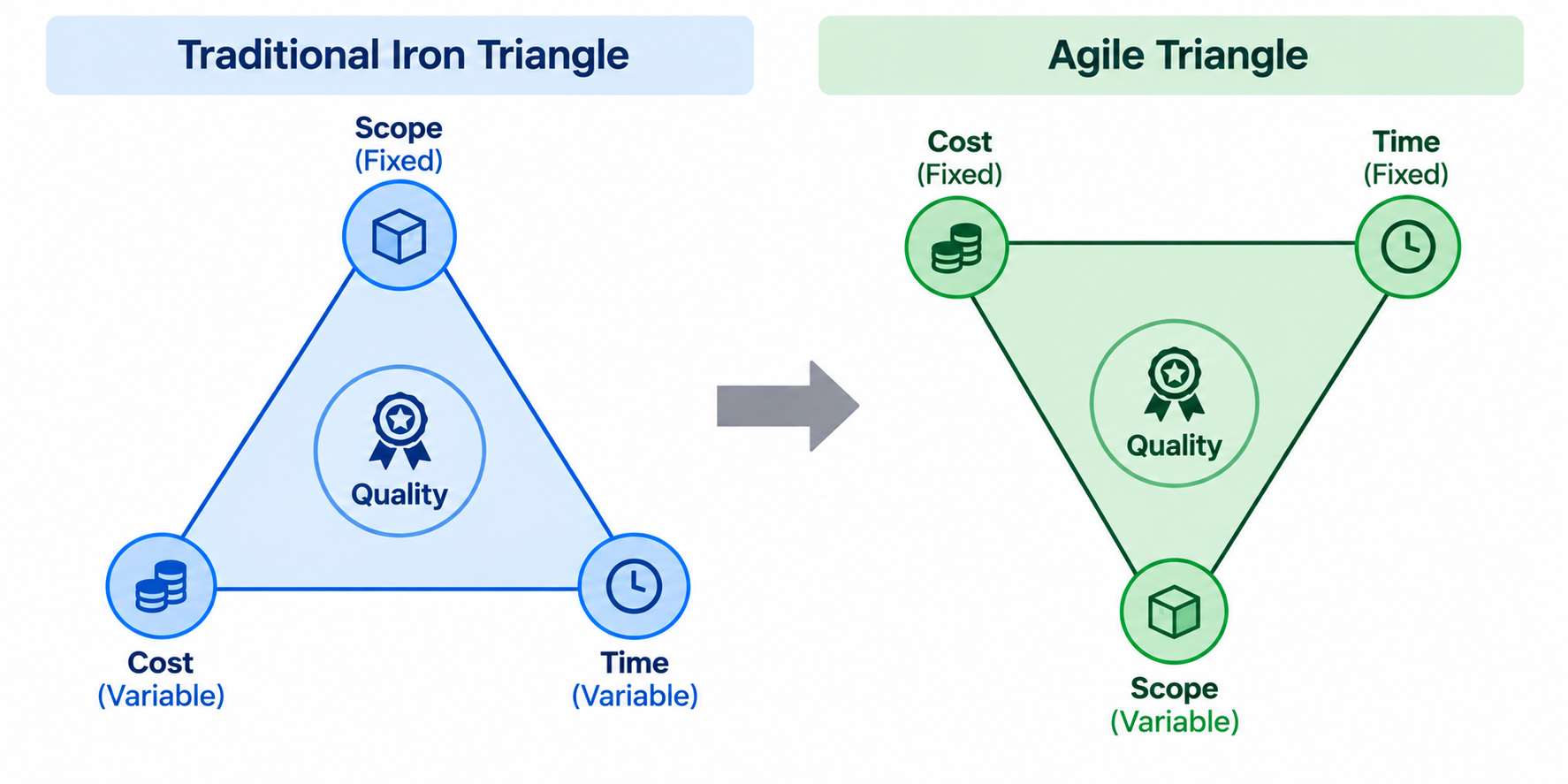
As the cost (budget) and time (schedule) are fixed, only the scope (features) is variable. This could be a good fit for hardware and firmware teams where budget, time-to-market, and quality stay rigid, but a variable scope means new features can be delivered incrementally.
↗️ Scaling Agile for Hardware Teams
As engineering firms scale up their teams, clear ownership in terms of roles and a well-documented framework become crucial. Following SAFe mechanisms helps buffer the management challenges presented by Moore’s Law:
- Program Increment cadence and synchronization: The framework supports strict, time-boxed, synchronized development cycles with incremental bursts of added value with every Program Increment.
- Such cycles allow regular technological pivots and reduce the risk of the project turning obsolete.
- This could also allow the project to exploit and source the latest market optimisations, keeping it on par with the growing computing power as mentioned in Moore’s Law.
- Lean Budgets: The framework maps Lean budgets directly to Value Streams. Thus, leadership could navigate dynamic fund reallocation towards new infrastructure faster than traditional projects.
Another point of focus would be to analyze the 10 SAFe principles and how their adaptations would look for hardware-based teams.
➡️ SAFe Principle #10 - Organise around value
Baseline: Traditional hierarchies slow down delivery. To maximize customer value and eliminate silos, organizations must align and continuously optimize around value streams.
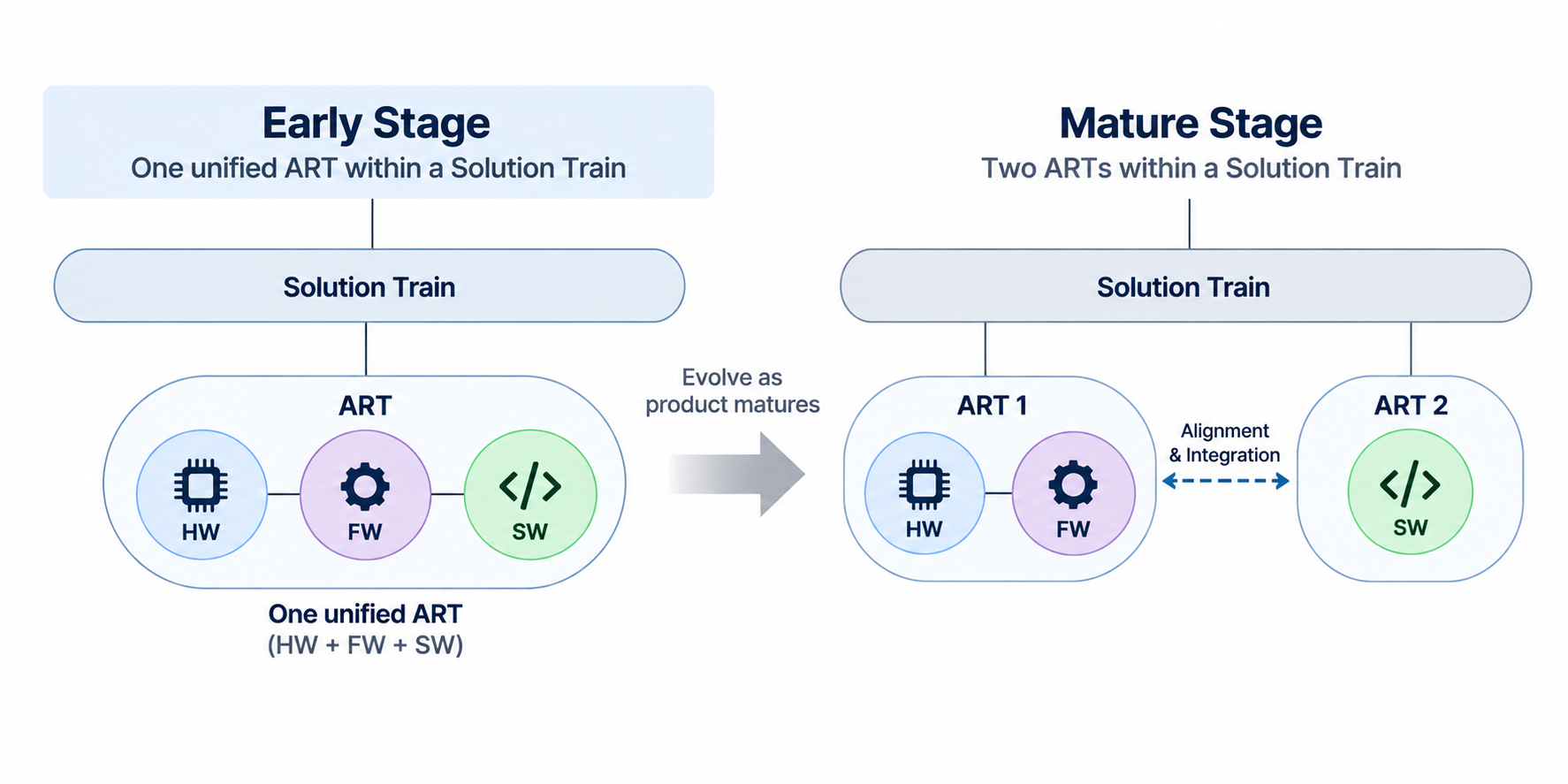
- Early Stage: Couple software, firmware, and hardware teams into a single Agile Release Train (ART). This minimizes cross-dependencies, speeds up integrations, and enables faster simulated testing and tighter feedback loops.
- Later Stage: As the product matures, split hardware and firmware into a separate ART so teams can focus exclusively on final product completion.
- Hardware Execution: Transition the hardware teams to a specialized Kanban system to pull verification tasks and board variations directly from a prioritized backlog.
The diagram below represents the customer value optimised within the Solution Train.
➡️ SAFe Principle #9 - Decentralize decision-making
Baseline: Empowering local domain experts reduces delays, improves product development flow, and enables faster feedback.
- Decentralized Decisions: Allow teams closest to the work to adapt to changing requests and standards via backlog reprioritization.
- Centralized Exceptions: Keep global strategic and foundational microarchitecture choices centralized to ensure product line continuity.
- Hardware Sourcing/Gates: Centralize high-risk commitments (like PCB tape-outs and long-lead component sourcing) while decentralizing local layout and component-level fixes.
➡️ SAFe Principle #8 - Unlock the intrinsic motivation of knowledge workers
Baseline: Lean-Agile leaders replace heavy-handed micromanagement with autonomy, mutual influence, and clear purpose to drive higher engineering engagement.
By eliminating bureaucratic constraints, organizations empower knowledge workers to take ownership of how they solve problems. This shift in leadership culture directly fosters cross-functional innovation and unlocks the true potential of engineering teams.
➡️ SAFe Principle #7 - Apply cadence, synchronize with cross-domain planning
Baseline: Continuous cadence provides a reliable operating rhythm, while cross-domain synchronization ensures different engineering disciplines integrate and collaborate predictably.
This synchronized cadence enables hardware, firmware, and software teams to align their design, testing, and manufacturing plans simultaneously. For regulated systems, these integrated milestones serve as objective safety checkpoints, identifying compliance non-conformances early to mitigate costly late-stage architectural re-engineering.
➡️ SAFe Principle #6 - Make value flow without interruptions
Baseline: Accelerate product development by actively identifying and eliminating bottlenecks, friction points, and rigid handoff delays that stop the progress of work.
Embracing specialization over isolated, rigid functional teams breaks down traditional departmental walls and creates unified, fast-moving cross-functional squads.
To maintain this momentum, hardware teams use clear operational boundaries to prevent execution gaps:
- Definition of Ready (DoR): Specify the exact documentation, requirements, and hardware interface definitions needed to make an upcoming story actionable, ensuring engineers never waste time on half-baked tasks.
- Technical Planning Spikes: Run dedicated technical spikes to conduct deep reviews with key stakeholders, proactively resolving unknowns before they cause costly physical redesigns and rework.
➡️ SAFe Principle #5 - Base milestones on objective evaluation of working systems
Baseline: Shift from subjective approvals to objective milestones to ensure development progress is evaluated using data from integrated, working systems rather than static checklists.
In hardware and chip design, this means replacing passive document reviews with hard, data-driven milestones like validated register maps, successful timing closures, and physical prototype test results.
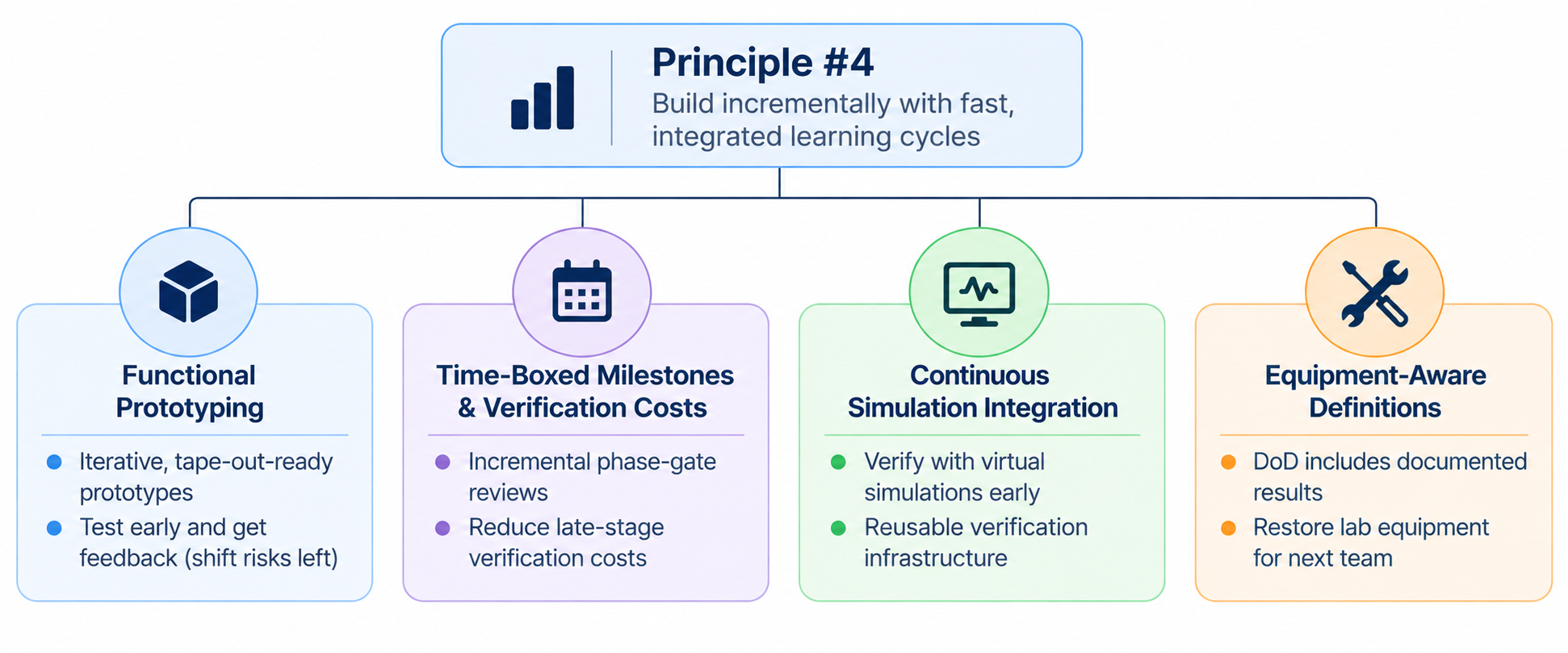
➡️ SAFe Principle #4 - Build incrementally with fast, integrated learning cycles
Baseline: Develop complex products by breaking massive designs into smaller, functional increments, shifting testing and verification earlier into the process to accelerate feedback.
- Iterative Prototyping: Build smaller, functional prototypes rather than waiting for full designs. This shifts risks left, catches defects early, and accelerates the delivery of Minimum Viable Products (MVPs).
- Time-Boxed Milestones: Transform high-risk approvals into regular, time-boxed incremental reviews, drastically reducing the cost of late-stage engineering errors.
- Continuous Simulation: Use virtual simulation tests to verify designs early, reducing substantial physical material costs and bypassing long factory lead times.
- Equipment-Aware Readiness: Enforce a strict Definition of Done (DoD) that requires teams to document test results and immediately restore shared laboratory equipment for the next team in sequence (as detailed in the diagram below).
➡️ SAFe Principle #3 - Assume variability, preserve options
Baseline: Instead of forcing teams to pick a single design path too early, maintain multiple flexible options for a longer period to reduce the risk of late discoveries and massive rework.
- Set-Based Design (SBD): Keep a diverse set of viable hardware design pathways open, testing multiple options against real-world data before committing to the final choice.
- Verified Baseline: Maintain a continuously verified, tape-out-ready design baseline as simulations mature. This allows you to pivot or add features without resetting the entire development lifecycle.
➡️ SAFe Principle #2 - Apply systems thinking
Baseline: A product is a complex mix of hardware, firmware, and software. Optimizing one department in a silo fails to optimize the whole system; everyone must understand the larger architecture.
- Cross-Domain Impacts: Recognise that small changes ripple instantly across domains. For example, a minor adjustment in a high-voltage analog parameter will immediately shift firmware calibration constraints.
- Architecture Gatekeeping: Empower the System Architecture role to act as a strict interface gatekeeper. This ensures complete cross-domain visibility and prevents cascading engineering defects across the train.
➡️ SAFe Principle #1 - Take an economic view
Baseline: Everyday engineering decisions must be made within a proper economic context by balancing trade-offs between risk, Cost of Delay, manufacturing, and operational costs.
- U-Curve Optimisation: Balance transaction costs, such as the high price of custom tooling and physical prototypes, against holding costs, which represent the economic penalty of delayed verification feedback.
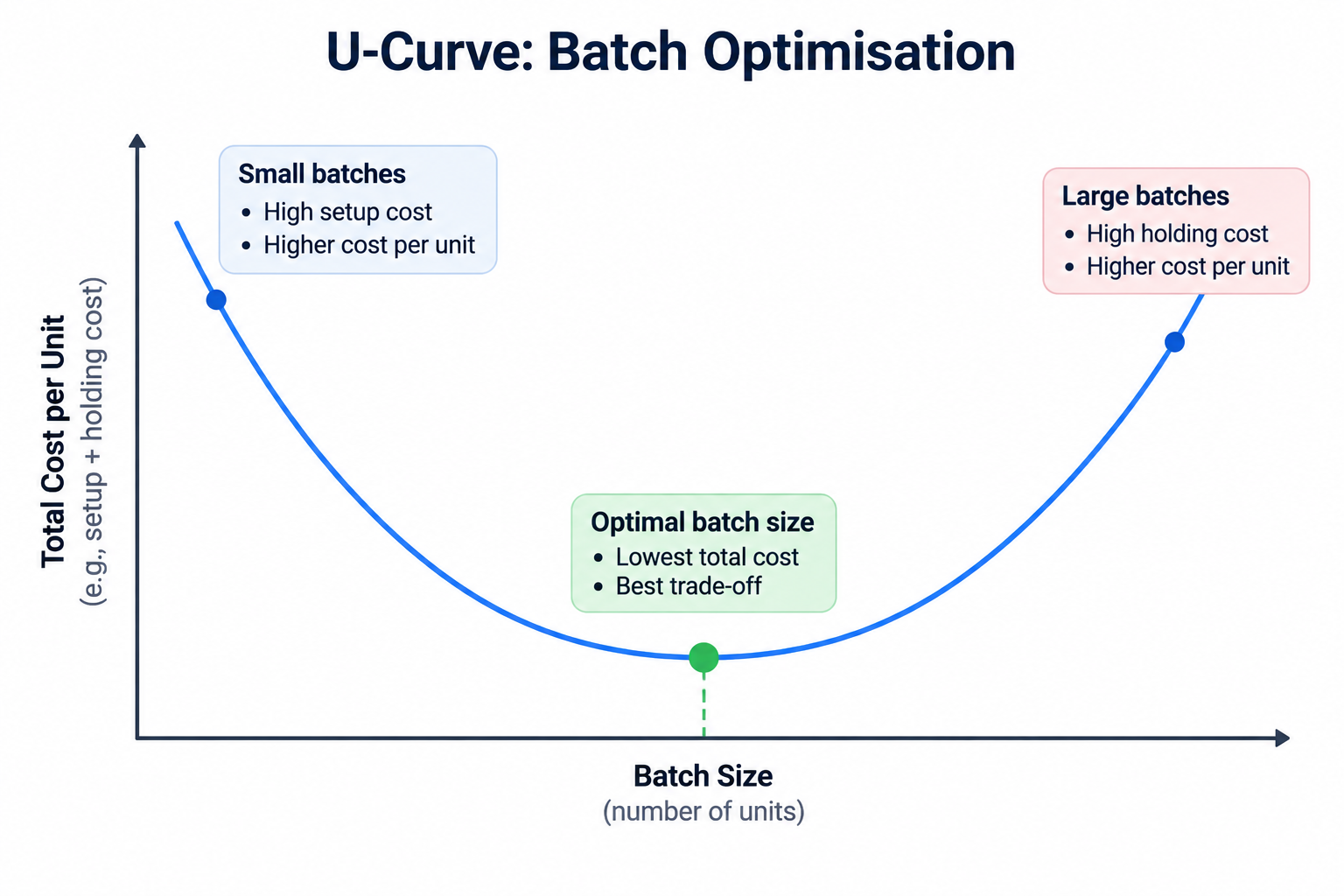
- Prototyping Economics: Leverage additive manufacturing and virtual emulator platforms to drastically slash the transaction cost per prototyping run. This shift mathematically optimizes the process for smaller, faster hardware increments.
To summarize, here are all the Agile facets from these principles that shall support hardware and firmware teams. These facets are categorised into three categories: Engineering and Testing Facets, Process and Governance Facets, and the Team Structure and Culture-related facets.
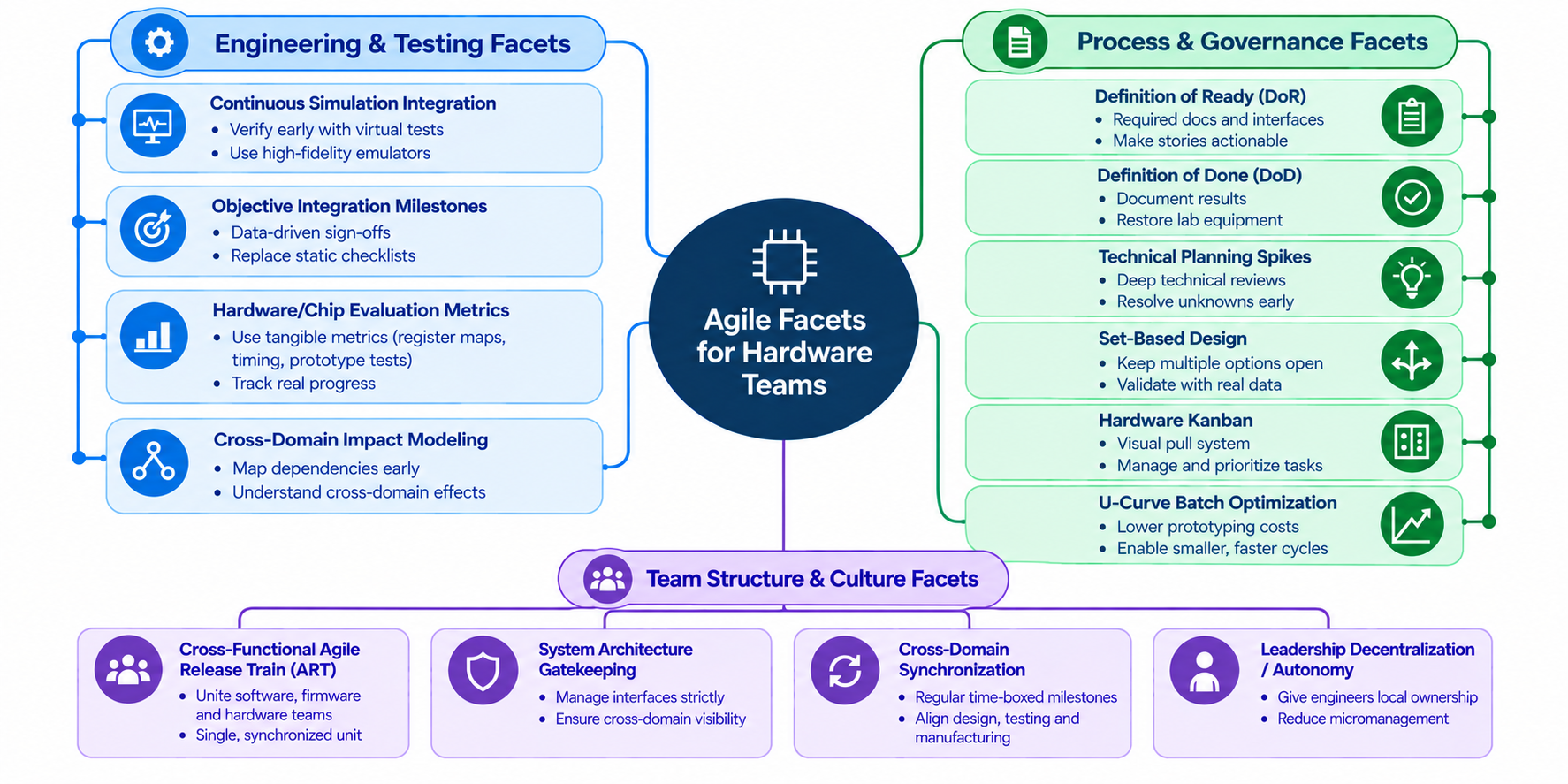
Implementing these Agile facets transforms hardware teams from isolated, siloed departments into fast-moving units that catch defects early through continuous simulation and clear requirements. By replacing paperwork checklists with data-driven milestones and clean lab practices, teams drastically reduce expensive physical respins and eliminate wasted engineering cycles.
⚒️ The Universal Hardware Blockers Framework
Establishing an Agile cadence for hardware teams is just one facet; however, such cadences shall work only if the actual technical blockers are well known to the leadership. Navigating the actual engineering bottlenecks ensures successful product delivery.
For a hardware- or firmware-related team, the leadership must identify and support the mitigation of any possible blockers. After some investigation and discussions with colleagues in such industries, a general list of basic blockers was collected and organized in a Universal Hardware Blocker table.
The table categorizes some of the commonly faced technical blockers across the semiconductor, automotive ADAS Radar, automated test equipment, sensor modules, medical devices, and avionics industries. The corresponding impact and the possible mitigation strategies are also documented.
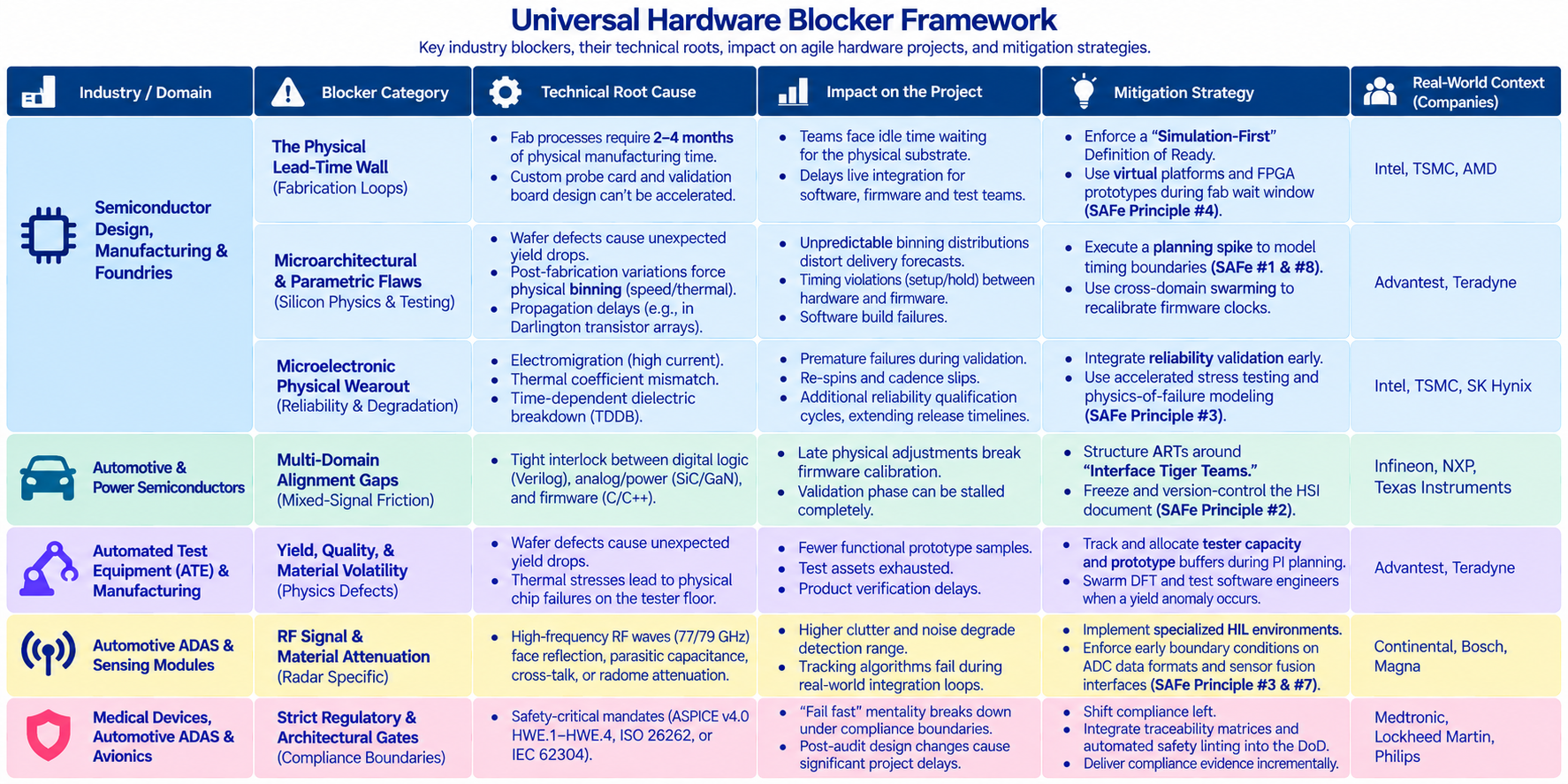
- In Semiconductor Design, Manufacturing & Foundries, long foundry manufacturing wait windows (The Physical Lead-Time Wall), performance sorting variations (Microarchitectural & Parametric Flaws), and device degradation variables (Microelectronic Physical Wearout) create integration idle time and erratic errors that mimic software regression, requiring a strict reliance on virtual emulation platforms and early reliability validation models.
- Across Automotive & Power Semiconductors, tight co-design requirements can lead to structural friction points (Multi-Domain Alignment Gaps), where late mechanical or analog tweaks instantly break firmware calibrations and stall validation phases unless managed by dedicated cross-functional Interface Tiger Teams.
- Similarly, variables in Automated Test Equipment (ATE) Environments (Yield, Quality, & Material Volatility) and physical high-frequency sensor anomalies in Automotive ADAS Modules (RF Signal & Material Attenuation) exhaust valuable testing assets and blind target-tracking algorithms, demanding structured prototype buffers and specialized Hardware-in-the-Loop (HIL) testing arrays.
- Finally, in heavily regulated safety-critical sectors spanning Medical Devices, Automotive ADAS & Avionics (Strict Regulatory & Architectural Gates), traditional "fail fast" cycles completely break down under hard compliance boundaries, making it mandatory for project leaders to shift traceability left by integrating requirement matrices directly into the daily Definition of Done (DoD).
Overall, successfully leading hardware-based teams requires leadership to inculcate a mindset of System-Level Engineering.
✅ Agile does not replace physical technical blockers; however, the framework helps surface them and provides the visibility to manage them proactively.
✅ A major learning has been that left-shifting the testing activities via simulations and virtual test loops is the key to achieving true agility in hardware-based teams.
✅ Engineering accountability over ticket routing: It is necessary to move past the functional silos and focus on urgent swarming and Tiger Teams when actual hardware blockers are faced in the team.
✅ Hardware-based teams need leadership who possess strong technical skills, who also look beyond bureaucracy and actually spend time going in-depth in understanding all the facets of the project.
✅ Continuous compliance eliminates process debt: In certain heavily regulated sectors governed by strong compliance standards, compliance cannot be a late-stage gate checklist. This should rather be a collective major focus for the team, such that traceability is left-shifted earlier and is embedded in every layer of the team’s activities.
⏱️ Conclusion
Conducting the deep-dive research for this article provided a clear opportunity to evaluate the inner workings of hardware- and firmware-based engineering teams. While standard Agile project management often focuses on software-driven execution, analysing macro-level hardware constraints like silicon binning, Darlington array propagation delays, and high-power shoot-through currents is essential for effective delivery execution. In a capital-intensive sector where a single post-tape-out mistake can delay a multi-million-euro project for months, leaders cannot rely on generic Agile cadences alone. The Universal Hardware Blockers Framework developed in Part 5 serves as a strategic cross-industry summary of these friction points, mapping out actionable mitigation tools like technical spikes and cross-functional swarming. Ultimately, building this strong technical foundation is what shapes a well-rounded Agile manager. Understanding these physical and material bottlenecks transforms a leadership role into a highly capable, cross-functional engineering partner.
📚 References
🔗 Personal discussions with colleagues from above-mentioned industries
🔗 Core Process Framework: "Hardware Teams in SAFe" Process Model. https://framework.scaledagile.com/applying-safe-to-hardware-development
🔗 Enterprise Case Studies: "Intel – Implementing SAFe for Information Technology" and "SK Hynix Memory Solutions – Adopting SAFe to Improve Enterprise-grade SSDs Production," Scaled Agile Case Studies Gallery. https://scaledagile.com/industry/semiconductors/
🔗 Extended Lean-Agile Principles: "SAFe Lean-Agile Principles" Core Documentation. https://framework.scaledagile.com/safe-lean-agile-principles
🔗 Hofman, Ralph and Azarmi, Davar. "Applying Agile and Lean Practices to Semiconductor Development," Gladwell Academy Knowledge Hub. https://www.gladwellacademy.com/knowledge/blogs/applying-agile-and-lean-practices-to-semiconductor-development
🔗 Lam, Johnny (Director, SKHMS) and Dr. Raman, Sanjeev. "SKHMS: SAFe Adoption for Chip Development," cPrime / SK Hynix Whitepaper Series. https://scaledagile.com/wp-content/uploads/delightful-downloads/2023/01/SK-Hynix-Case-Study-Download.pdf
🔗 International Standard ISO 26262-5:2018 (Road vehicles — Functional safety — Part 5: Product development at the hardware level).
🔗 International Standard IEC 62304 (Medical device software — Software lifecycle processes).
🔗 intacs® SPICE Center Quality Center: Automotive SPICE (ASPICE) v4.0 Process Assessment and Reference Model for Hardware Engineering (Processes HWE.1 through HWE.4).
🔗 Deming, W. Edwards. Out of the Crisis. The MIT Press, 2018.