Driving a 500+ problem report backlog burn-down amidst ASPICE SUP.9 audit pressure
Disclaimer
This case study is based on an actual challenge encountered at work, redesigned as a simulation to reflect real-world complexities within an automotive Radar project's Solution Train. The diagnostics, interventions, and structural outcomes combine direct practical experience with my own strategic analysis to demonstrate structured problem-solving methodologies. All data, diagrams and strategies are my original creations.
📌 Primary Competencies
Release Train Coordination (RTE) and Facilitation | Agile Governance | ASPICE SUP.9 (Problem Resolution Management)
🌐 Project Context and Team Setup
- Overall Project Architecture: The overall project team is a Large-Scale Solution Train consisting of two distinct Agile Release Trains (ARTs) and some specialised supporting functional teams.
- ART 1 (Vehicle Interface): 8 core Vehicle Interface teams (including Architecture and Integration) and dedicated Software Testing teams
- ART 2 (Algorithm Functional): 7 Algorithm Development functional teams, alongside Vehicle Testing and HiL (Hardware-in-the-Loop) teams
- Supporting Cross-Functional Teams: Focused on Governance, Facilitation, Supplier Management
- Methodology: Scaled Agile Framework (SAFe) with a hybrid Scrum/Scrumban approach at the team level
- Delivery Cadence: Regular Customer delivery milestones are governed by the gate release process. The project is in an active build phase with future releases actively planned, on a time-boxed Program Increment (PI) cadence.
⛔️ Problem Statement
The collective Problem reports (PRs) across all ART Backlogs cumulatively have climbed to a critical volume of 500+ open tickets. This backlog is a mixture of:
- Customer-reported problem reports
- Internal software defects
- Quality gaps/Optimisation topics
- Architectural technical debts
The tickets are of varying statuses, from New, In Progress, Ready for Verification and Verified
Despite extensive tracking mechanisms, the net inflow of tickets has consistently outpaced the outflow. An upcoming ASPICE SUP.9 (Problem Resolution Management) Audit has added to the pressure and requires brainstorming and a sustainable burn-down strategy that will not derail the upcoming feature release timelines. As a Release Train Engineer, it is expected to lead this brainstorming strategy and track the execution to completion.
Duration Constraint: 4-week execution window
⚠️ Pre-Requisites/ Assumptions/ Current Baseline
A Problem Report (PR) is a bug, a deviation, or a finding from a specification discovered across any stage of the SDLC lifecycle. In Jira, this is a ticket type that has a workflow from discovery to verification of the issue.
As per SUP.9 guidelines, foundational processes are already active in the project:
- A well documented and propagated Problem Report burn-down process
- Weekly Burn-down tracking meetings and reporting dashboards
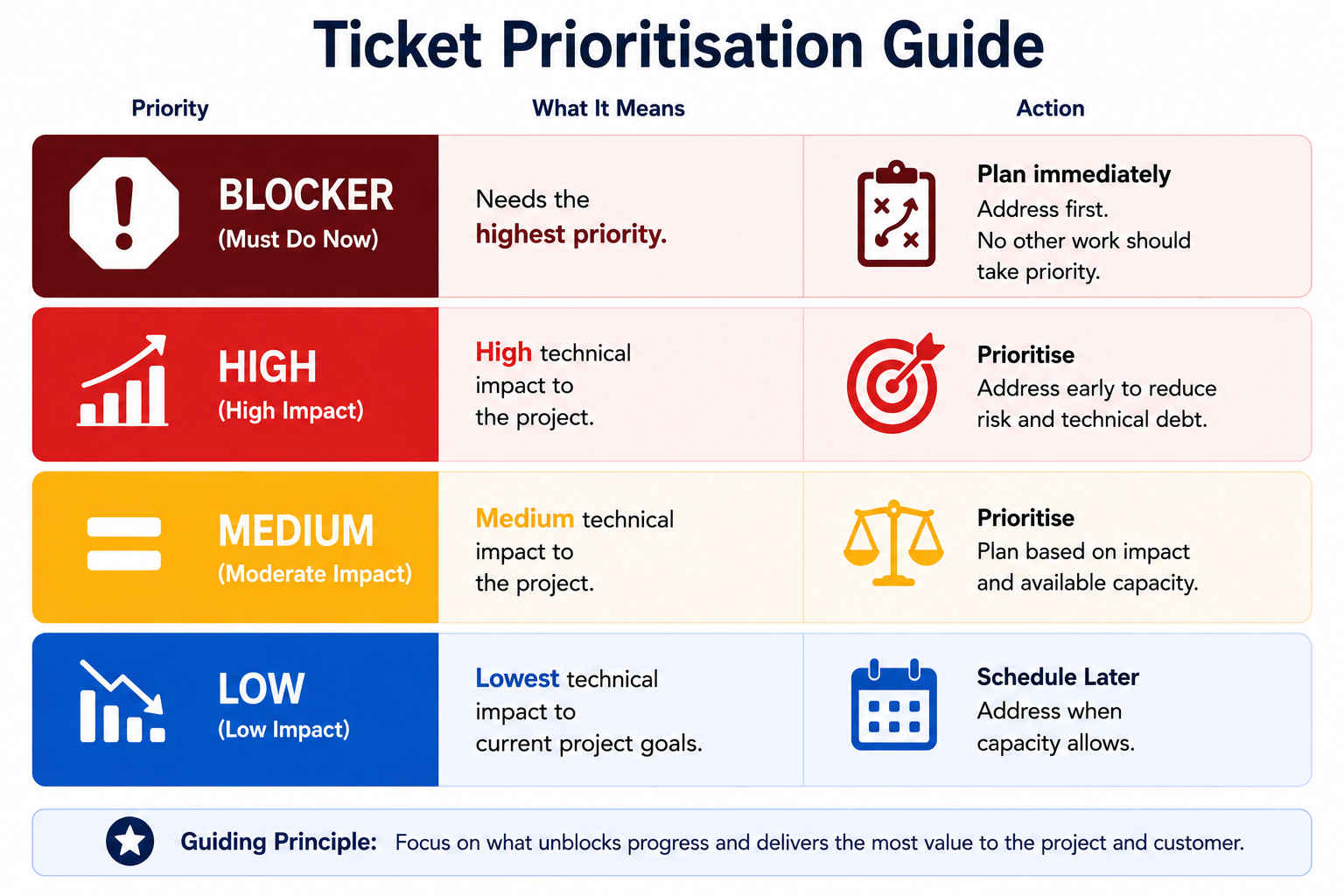
- A strict prioritisation based on technical and business impact
🔍 Planned Strategic Intervention
- Root Cause Analysis and Brainstorming
Strategy brainstorming is not possible without first understanding the root causes behind the issues faced. A two-tier diagnostic strategy was executed:
- Individual Scrum Team Retrospectives to uncover the specific pain points of each team
- Solution-Wide Ishikawa (Fishbone) Analysis session with a higher and tighter group of stakeholders to aggregate all findings, cross-reference dependencies, and remove duplicate root causes.
Below is the outcome of the Solution-Wide Fishbone Analysis. Each identified root cause was evaluated to find tangible, practical, and time-boxed short-term and long-term action items that are highly feasible. Seven separate branches were identified, along with ~ 27 root causes, each highlighting a distinct facet of the Team's concern.
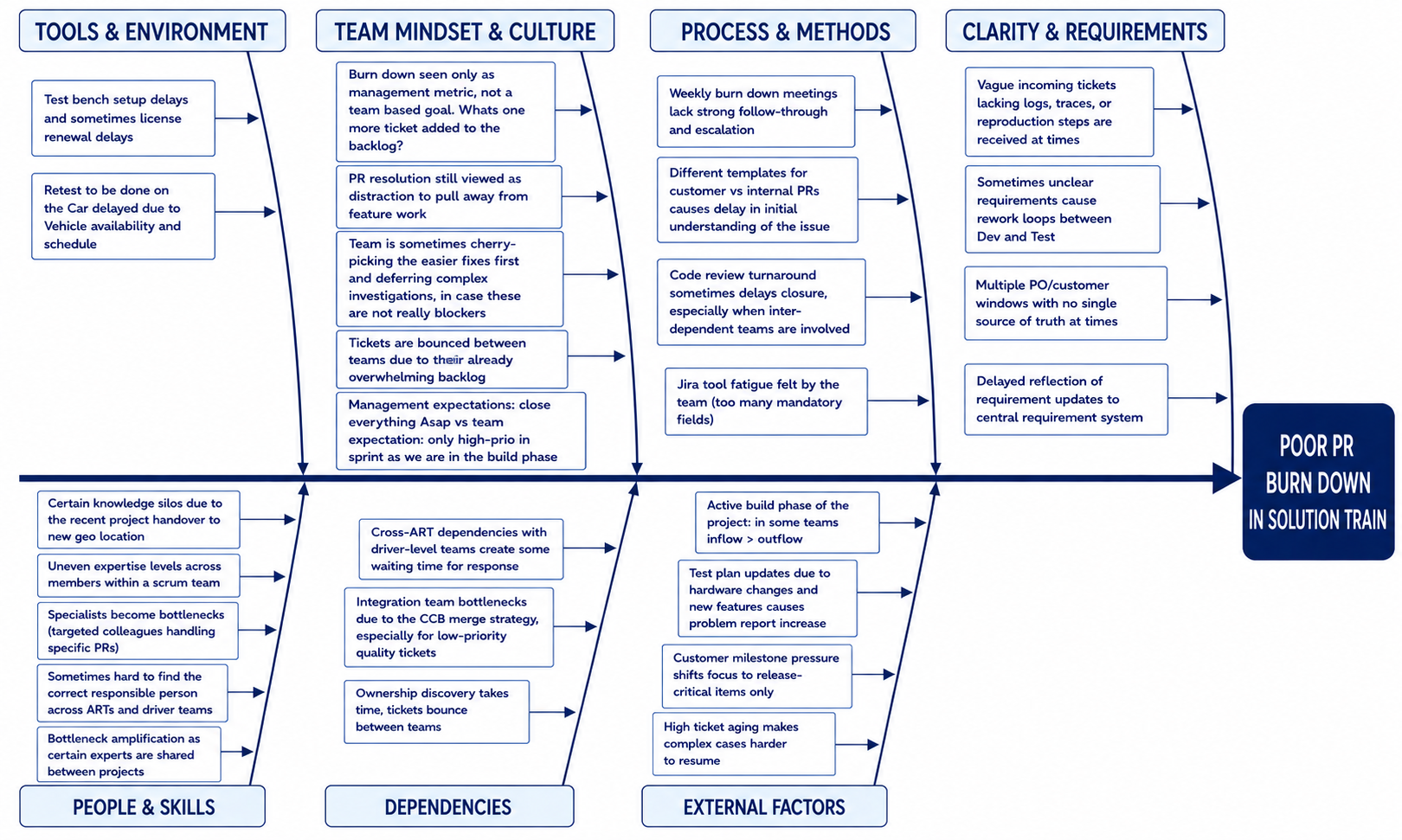
The seven separate branches are:
- Team Mindset and Culture: This branch describes alignment issues and a disconnect between management expectations and team capacity. Overwhelmed by heavy workloads, the team prioritises easy fixes over complex tasks and views pull requests or management metrics as distractions rather than collective goals. As a result, there is fragmented ownership, where tickets are deflected and sprint focuses are misaligned with respect to urgency.
- Process and Methods: This branch describes the Jira tool fatigue and the feeling of being process-heavy amidst a growing backlog. There are also inconsistent problem report templates between internal and Customer tickets. Aside from this, poor meeting follow-through is another facet.
- People and Skills: There are knowledge silos as well as uneven expertise, which create dependency bottlenecks. Another root cause was the recent handover of the project to a different geographic location. As specialists are shared among projects, they create bottlenecks due to their unavailability.
- Dependencies: Cross-ART dependencies and Integration merge strategies for quality topics slow down ticket closure. A lot of time is also spent clarifying ownership within other ARTs.
- Tools and Environments: This branch considers license renewal and setup delays in test bench setups. Additionally, certain tickets that require verification directly on the vehicle are dependent on vehicle availability.
- Clarity and Requirements: Poor documentation and fragmented information cause constant rework. Requirement clarifications are not documented centrally as a single source of truth before they are recorded in the requirements management system.
- External factors: This branch discusses how milestone pressure and growing inflow make complex investigations harder to resume. Continuous Test Plan updates due to new feature implementations and hardware add more inflow to the backlog.
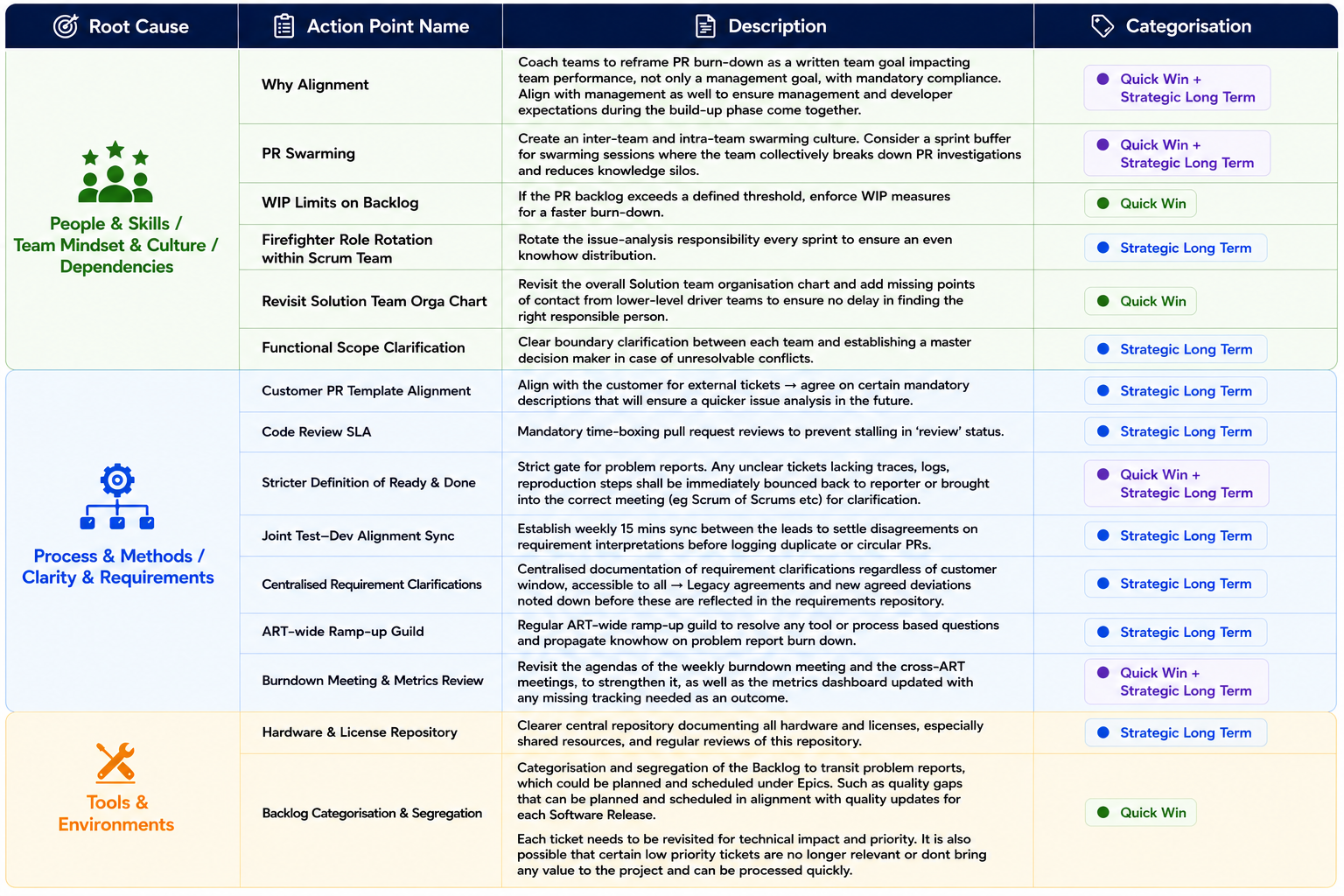
Consequently, as an outcome of brainstorming solutions for these root causes, an action plan was prepared, consisting of:
🟢 Quick Wins → Immediate, quicker interventions
🔵 Strategic Long Term improvements → Longer-Term structural interventions
🟣 Action point is a hybrid of both options above
Each action item is assigned to primary owners within the team to ensure these points are successfully realised to completion. Close to 15 strong actions focused on resolving each of the root-cause branches are derived. The table summarises each of the action points that were brainstormed.
- Setting up a Focused and Time-Boxed Taskforce
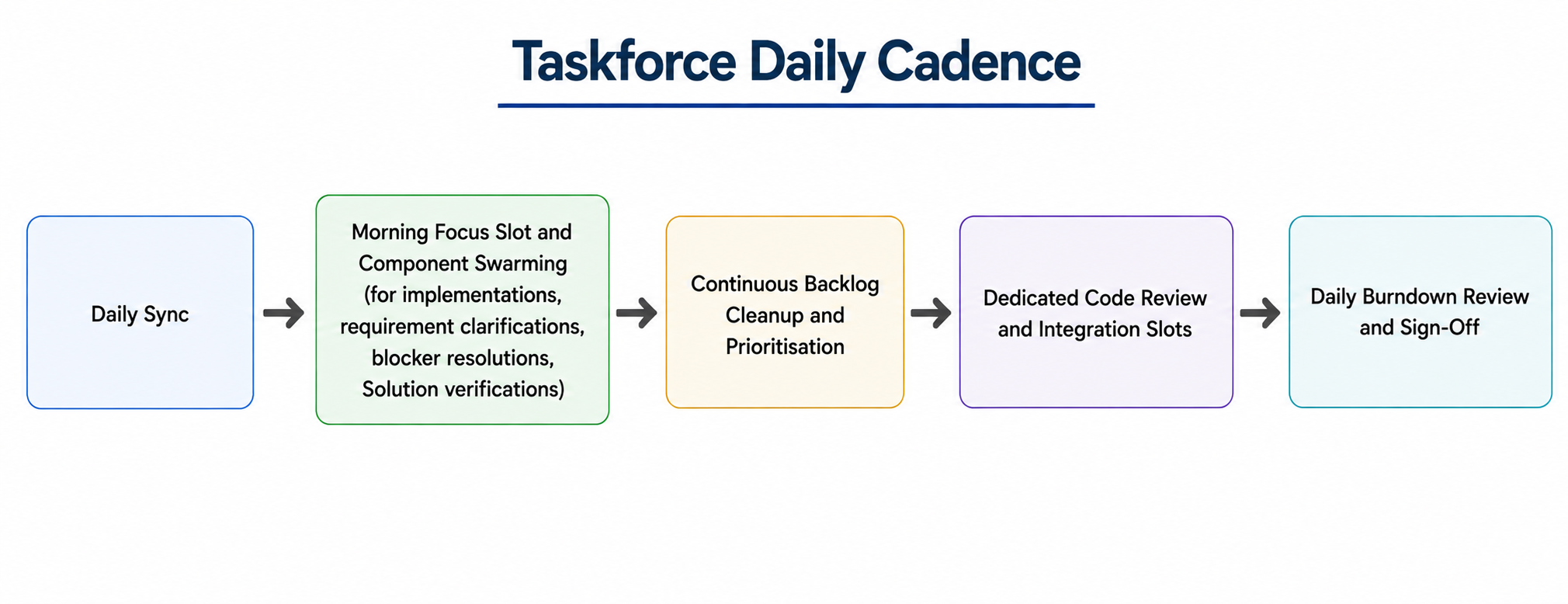
After uncovering the root causes and brainstorming specific action points, the focus shifts to the upcoming audit deadline. As a result, there is a clear need to transition from business-as-usual operations to a time-boxed taskforce to achieve a cleaner backlog.
A daily taskforce and focused Way of Working (WoW) was set up with the following cadence:
There also needs to be a strict ‘Definition of Ticket’ Gate to validate that each ticket contains clear software versions, step-by-step reproduction instructions, necessary traces, and comprehensive descriptions. Any unclear tickets are discussed in a swarm meeting with the reporter to obtain the required clarification.
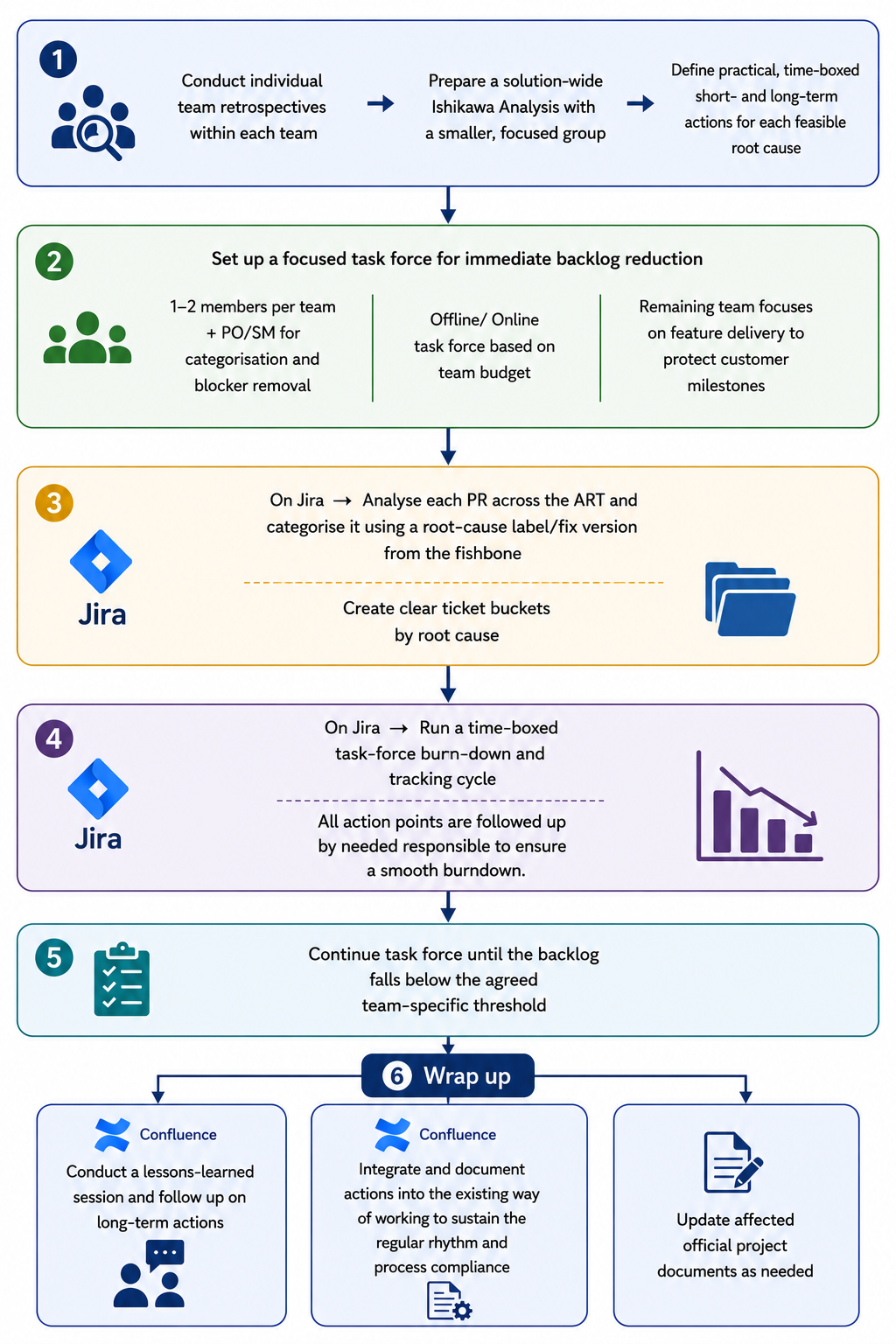
- Overview of the Strategic Intervention
An overview of the entire strategic intervention is detailed below:
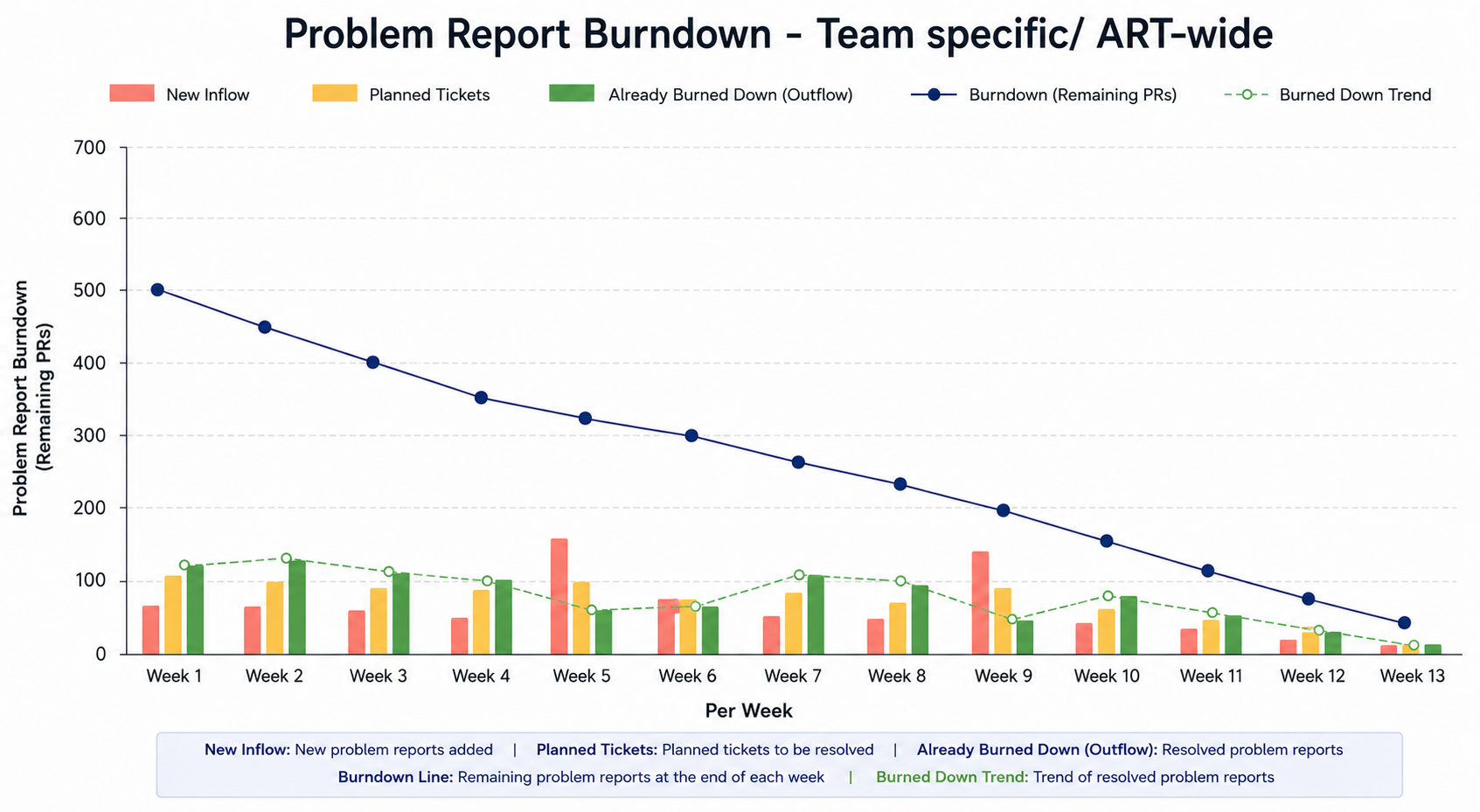
Parallel continuous burn-down tracking is necessary to monitor the trend of the Problem Reports as mentioned below. The List of revised metrics being tracked are mentioned under Case Study key takeaways.
As a wrap-up activity once the Taskforce is suspended, the team will transition back to a daily operational cadence equipped with an upgraded Problem Report burn-down strategy. Additionally, a lessons-learned session will be conducted, followed by updates to all necessary project documentation.
⛳️ Expected Outcome and Results
The goal of this Taskforce is not to achieve zero tickets, but rather to establish strong backlog hygiene, a state of control, and a revised standard operating procedure. Every ticket in the backlog must be reviewed, prioritised, risk-assessed for technical impact, and predictably planned within a structured burn-down framework.
Overall, the primary outcomes include:
- Clean Backlog Hygiene → Every ticket is reviewed, missing descriptive attributes are filled, and no tickets remain unassigned or lack a clear investigation path.
- Predictable Velocity → A positive, downward burn-down trajectory supported by a stabilised Way of Working (WoW).
The Taskforce remains active until the backlog shrinks to a controllable state and all tickets pass the hygiene criteria.
As a final result, we achieve:
- ~50% Backlog Reduction → A sustained downward trend combined with rigorous ticket hygiene.
- Stabilised Sprint Predictability → Driven by a comprehensive review of the PR backlog and technical debt.
- Accelerated Cycle Times → Faster average resolution times for software defects.
- Enhanced Product Ownership → Fully optimised ownership boundaries and a revised Standard Operating Procedure (SOP).
💎 Project Artifacts
- Scrum Team Retrospectives (Aggregated outputs from individual team sessions)
- Solution-Wide Ishikawa (Fishbone) Diagrams (Root cause analysis documentation)PR Burn-Down & Quality Metrics Dashboards
- Lessons Learned Register
- Updated Project Documentation (Revised Problem Report Burn-Down Strategy and Master Project Plan)
💡 Key Takeaways and Learnings
✅ Process compliance must not be viewed as an administrative burden, but rather as an essential enabler of quality and predictable project delivery.
✅ Simply documenting a Problem Report strategy or hosting tracking meetings is insufficient for true process compliance. It is vital to look beyond surface-level metrics to uncover the systemic root causes of process non-compliance.
✅ Mapping Performance to ASPICE SUP.9 Base Practices (BPs): Connecting tracking metrics directly to the foundational Base Practices of SUP.9 is critical for sustainable quality assurance:
➡️ BP1 - Formulate a Problem Resolution Strategy
A clear, well-documented resolution strategy must be propagated across the team. This is validated when all uncovered action items are tracked to closure and integrated into the standard Way of Working (WoW) after the Task Force.
➡️ BP2 - Uniquely Identify and Record Problems
Problem report descriptions in Jira must demonstrate absolute completeness and clarity (e.g., detected version, step-by-step reproduction instructions). This baseline is secured through a comprehensive backlog review and cleanup as part of this Taskforce
➡️ BP3 - Diagnose Problems
Thorough technical investigations must be documented directly in the tickets to establish a clear understanding of project impact. There is clearer functional ownership and reduced bouncing of tickets between Scrum teams
➡️ BP4 - Classify and Analyse Problems
Establish a strict prioritisation framework to evaluate the urgency of every ticket in the backlog, utilising the specific filtering measures deployed during the Taskforce.
➡️ BP5 - Track Problem Resolution to Closure
Continuous monitoring must govern the following key quality metrics:
- Continuous tracking of the burn-down trajectory against the new ticket inflow rate.
- Problem Report Rejection Rate: Monitoring incoming tickets returned to the reporter due to insufficient or missing data.
- Backlog composition segregation: Categorising the backlog by priority, software defects, and technical debt.
- Problem Report Age Distribution: Grouping tickets by cycle time to ensure critical bugs do not exceed defined resolution thresholds.
- Clear Definition of Ready and Clear Definition of Done: Tracking compliance with strict entry and exit criteria
- Problem Report Re-opening Rate: Tracking tickets reopened due to failed verification and required rework.
- Problem Report Status segregation: Analysing ticket status to flag stagnant issues and immediately address workflow bottlenecks.
- Traceability checks: Uncovering traceability gaps between investigations, code commits, verification logs, and requirements updates.
➡️ BP6 - Verify Problem Resolution
Satisfied through a combination of the swarming strategy and the long-term action items defined by the Taskforce.
➡️ BP7 & BP8 – Provide Status Reports & Ensure Bidirectional Traceability
Fully realised through the automated dashboards, traceability audits, and key performance metrics outlined above.
⏱️ Conclusion: The Universal Challenge of Backlog Accumulation
This case study addresses a very common scenario across all industries: the steady accumulation of backlog, which, if left unchecked, can deeply affect compliance, predictability, and team morale. Additionally, as observed in most workplaces, in such scenarios, the first point of action is usually to enforce stricter tracking with the team. However, in contrast, the most effective fix is always to understand and treat the real root causes of the issue, so that the fix will be long-lasting and sustainable in the long run.
This case study also highlights the critical high-stakes scenarios that Scrum Masters and Release Train Engineers (RTEs) play in enterprise delivery. It serves as a repeatable blueprint for how agile leadership directly ensures predictable execution.