Organising Remote PI Planning at Scale
Disclaimer
This case study is based on an actual challenge encountered at work, redesigned as a simulation to reflect real-world complexities within an automotive Radar project's Solution Train. The diagnostics, interventions, and structural outcomes combine direct practical experience with my own strategic analysis to demonstrate structured problem-solving methodologies. All data, generated diagrams and strategies are my original creations.
📌 Primary Competencies
Release Train Coordination (RTE) | Scrum Master Facilitation | Distributed Agile | SAFe PI Planning
🌐 Project Context and Team Setup
- The project under consideration is an ADAS Radar Project, requiring tight coordination and regular planning to meet critical customer release timelines.
- The project follows the Scaled Agile Framework (SAFe) on a time-boxed Program Increment (PI) cadence. The Agile Release Train (ART) comprises ~70 members distributed across 13 Scrum teams covering integration, architecture, requirements, functional development, and software testing.
- Each team is supported by a dedicated Scrum Master and a Product Owner.
⛔️ Problem Statement
Following the company's transition to a hybrid/remote work model, combined with a globally distributed ART, conducting the PI Planning event offline was no longer viable. As the Release Train Engineer (RTE), the primary objective was to collaborate with the Scrum Masters to design, implement, and facilitate a sustainable, entirely remote PI Planning framework.
⚠️ Pre-requisites
PI Planning (Program Increment or Planning Interval Planning) serves as a core alignment meeting of the ART and has the following features:
- An ART-wide event organised every 8–12 weeks, typically lasting 2–3 days
- Core Objective: All teams within the Agile Release Train collaboratively commit to a set of PI objectives and prioritise their backlogs to deliver a high-value program Increment.
- The leadership provides ART-Wide high-level objectives, an overview of the business and other useful inputs to guide the team towards a unified goal.
- As per the SAFe framework, the typical Agenda of a PI Planning are:
- Context and Vision overview: Business Context, Product Vision, Architecture Vision, and Planning Context sessions to communicate project progress, architectural roadmaps and execution guidelines.
- Team Breakouts: These are collaborative sessions where individual teams conduct detailed capacity and project planning.
- Governance/ Overall Review: Management Review, Problem-Solving, Risk ROAMing, Confidence Voting, and Retrospectives conducted to streamline the project at the ART-Level.
Regardless of whether the event was executed offline or online, the non-negotiable success criteria and desired expectations remained identical:
- Senior managers present the current state of the project and the business objectives to the teams.
- The Product and Architecture visions are presented to the entire ART.
- Individual teams set their objectives and plan their backlogs, including discussions on dependencies, risks, and team capacities.
- Management reviews the overall ART-wide planning and makes necessary adjustments.
- Confidence votes and retrospective points are collected across the ART.
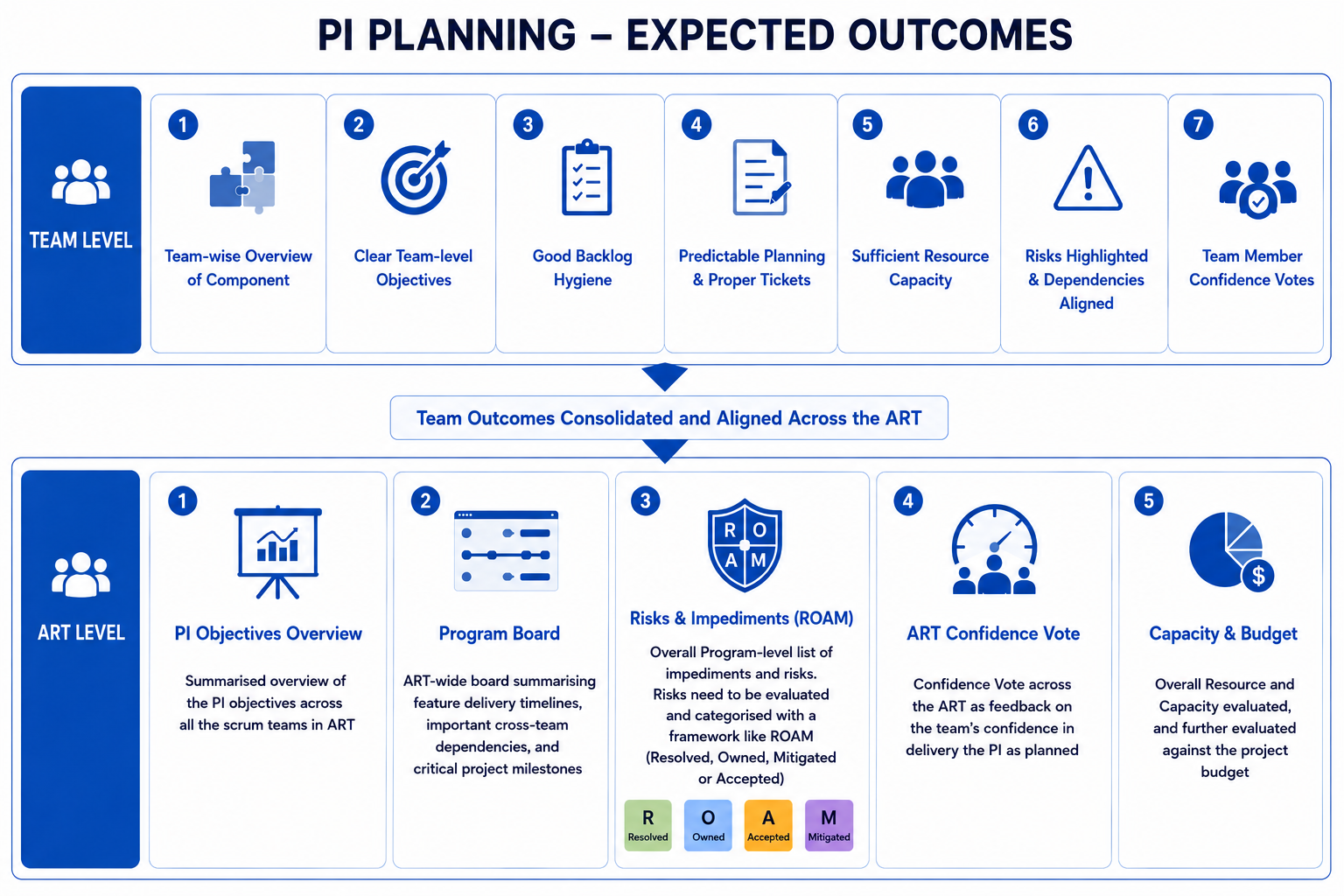
Overall, the PI Planning event must ensure that the Program Increment delivers a valuable increment to the project.
The major factors and challenges faced during an online PI Planning event are:
➡️ Fast communication and transparency during planning: This is extremely important, as a significant amount of dependency resolution, negotiation, and cross-team coordination is required during the event. Issues must be tackled quickly rather than dragged into multiple follow-up meetings. There is also a critical need to ensure trust and transparency across all teams.
➡️ Tangible and reliable outcomes at the end of the event: All expected outcomes must be achieved to derive a predictable project plan. Therefore, uniform planning across all teams must be ensured for the event to be successful. Another major challenge is delivering all necessary work products within tight time constraints.
➡️ Challenging facilitation overhead due to a distributed train: As it is impossible to provide on-the-spot facilitation support to every team member online, the communication framework must enable each team member to be self-organising and take ownership of their respective components.
These challenges must be taken into consideration when designing the remote PI Planning framework.
🛠️ Structuring the Remote PI Planning Framework
The key elements that ensured a successful remote PI Planning event were:
- Thorough Pre-Planning and Preparation
- Detailed preparation and comprehensive pre-planning were critical to preventing delays and execution issues during the actual planning event.
- This preparation was managed across multiple levels by the entire train, as outlined below:
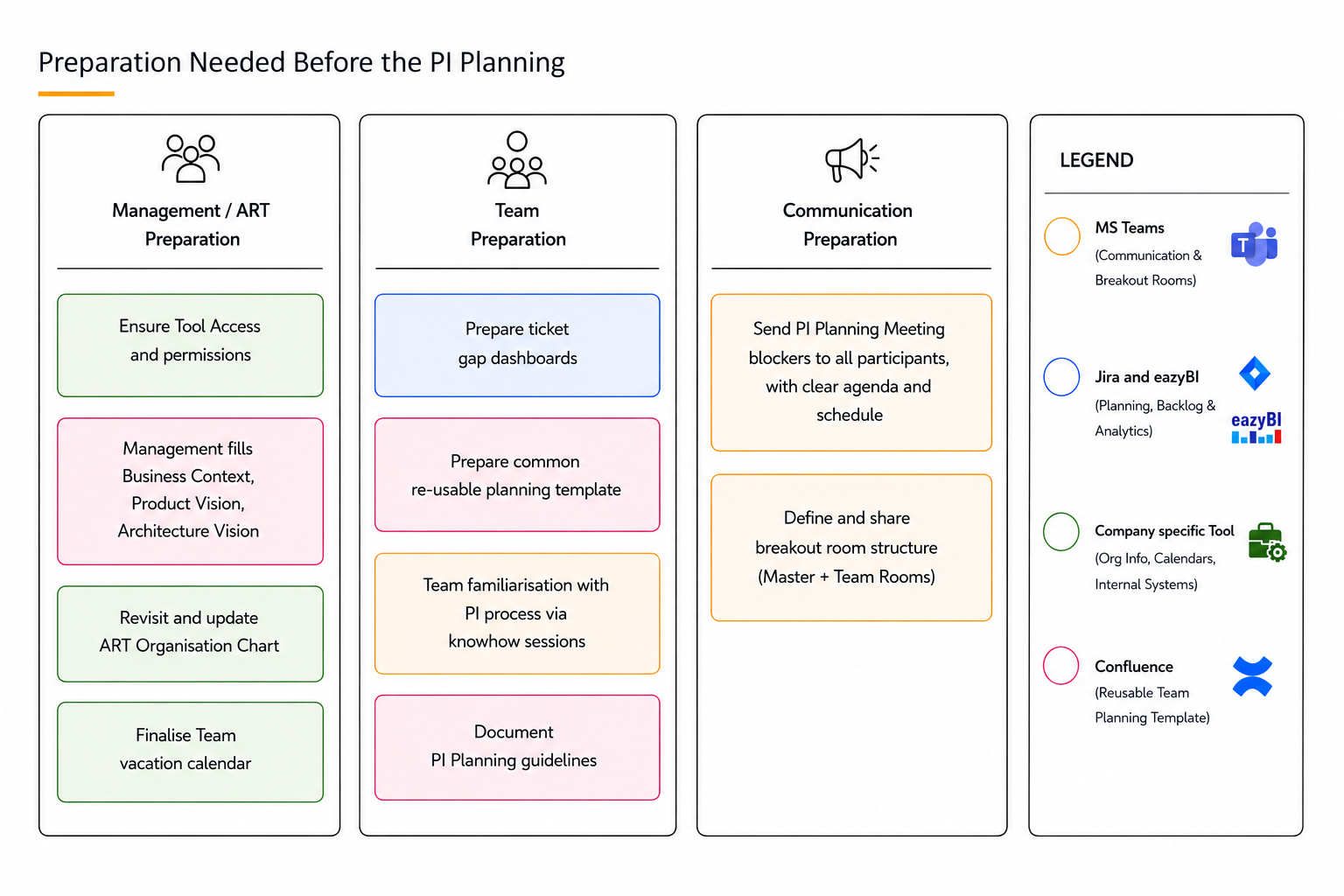
- ART-Level Preparation: Business owners and project managers defined clear ART objectives beforehand and prepared the business context overview along with the product vision. This provided the rest of the ART with proper direction and clear priorities to consider while preparing team-level inputs during the event.
- Operational Readiness: Team organisation charts and vacation calendars were updated to accurately reflect capacity. Ticket backlogs were refined and cleaned up. To facilitate this, easy-to-use dashboards for backlog hygiene were created, and clear documentation guidelines were provided to the teams. Additionally, a knowledge-sharing session was organised prior to the event to familiarise team members with the remote planning process.
✅ Due to extensive pre-planning and preparatory activities, valuable time was saved during the actual planning event. Each team member was familiarised with the process and had all the necessary inputs beforehand. This upfront transparency regarding expected outcomes significantly reduced the facilitation overhead that would have otherwise been encountered during the live event.
- Creation of a common Reusable Planning Template
- A major point of concern when moving the planning event online was the reduction in facilitation control, making it harder to monitor the planning of all teams compared to an offline event. This challenge arose because remote teams naturally performed their planning in digital silos.
- To ensure uniform planning across the ART and overcome the challenge of effectively facilitating a distributed event, a common reusable template was designed in Confluence.
- This template was then customised and used by every Scrum team for their team-level planning. Below are the key sections included in the common template to enable independent planning within the teams:
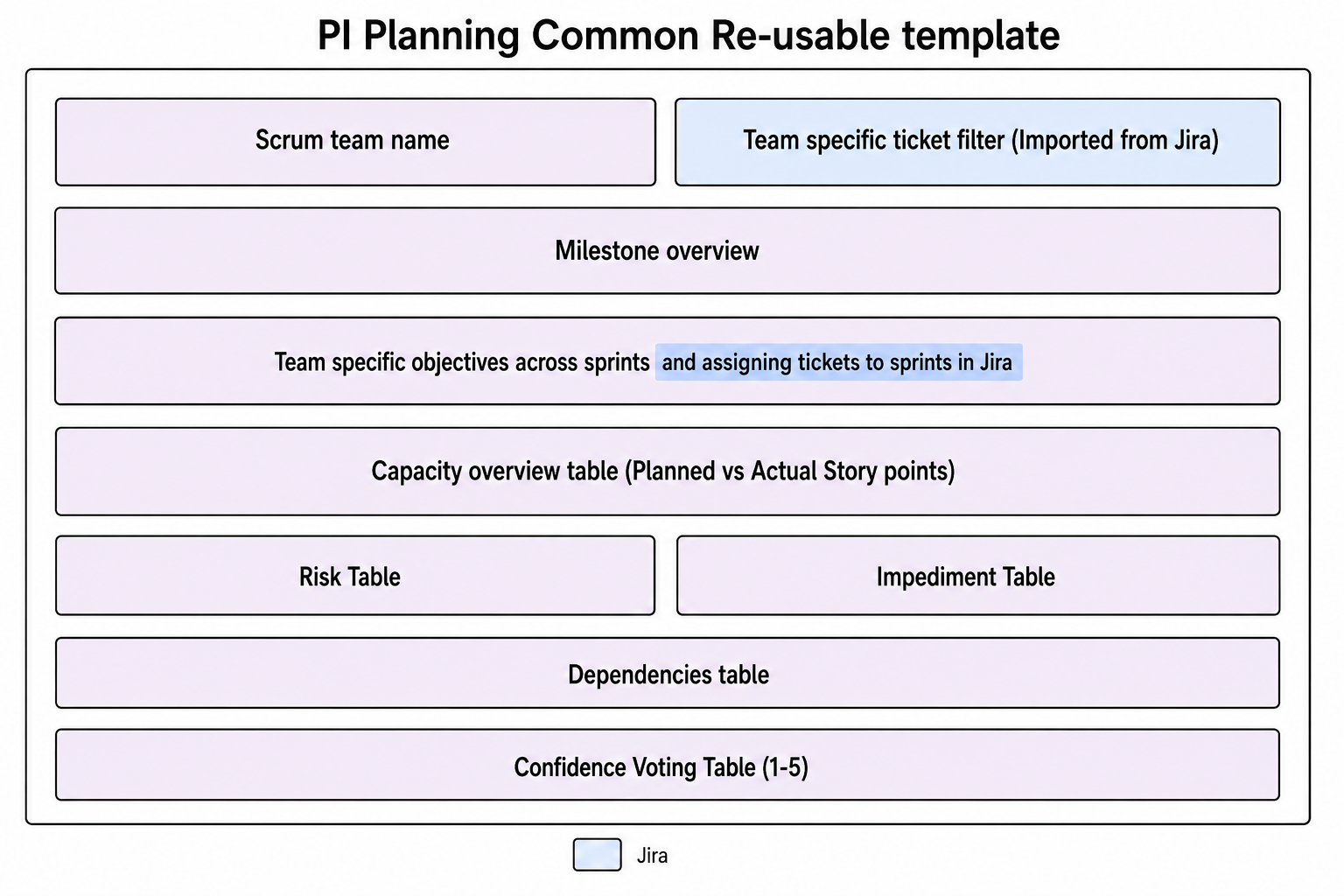
- As part of the pre-planning phase, a customized, team-specific planning page was generated from the master template prior to the live event for every Scrum Team.
- The milestone overview made ART-level objectives visible on every team planning page, while team backlogs were migrated and embedded into the template via Jira filters. This provided teams with all necessary inputs for their individual planning sessions.
- Beyond defining team-specific objectives, realistic planning was visualised by assigning tickets directly to respective sprints in Jira. Teams set feasible goals by actively balancing their targets against actual available sprint capacity.
- Teams documented localised risks, impediments, and cross-team dependencies directly within the template. Presenting these during the final review ensured their concerns gained full visibility across the entire ART.
- To conclude the process, an individual confidence vote was obtained from each participating team member.
✅ A reusable template provided a single reference point for all teams, establishing uniform planning across the ART. This approach promoted transparency and ownership within each team, which would have been otherwise highly difficult to achieve in a remote setting.
- Reliable Communication Framework
- All meeting invitations for the PI Planning event were shared with the teams beforehand, with a clear agenda attached to each. This established a reliable communication framework that tied the entire train together during the live event.
- The framework supported spontaneous dependency clarifications and provided easy access to every team’s planning session, effectively bridging the distributed setup.
- Two distinct types of virtual breakout rooms were setup:
- Master Breakout Room: Dedicated to all ART-level alignments, briefings, and reviews.
- Team-Level Breakout Rooms: Each Scrum team had a dedicated breakout room for capacity planning and objective setting. To accelerate dependency resolution and ensure transparency, all rooms were accessible to everyone across the ART. A centralized list of direct links was embedded in the main agenda, enabling seamless navigation between rooms.
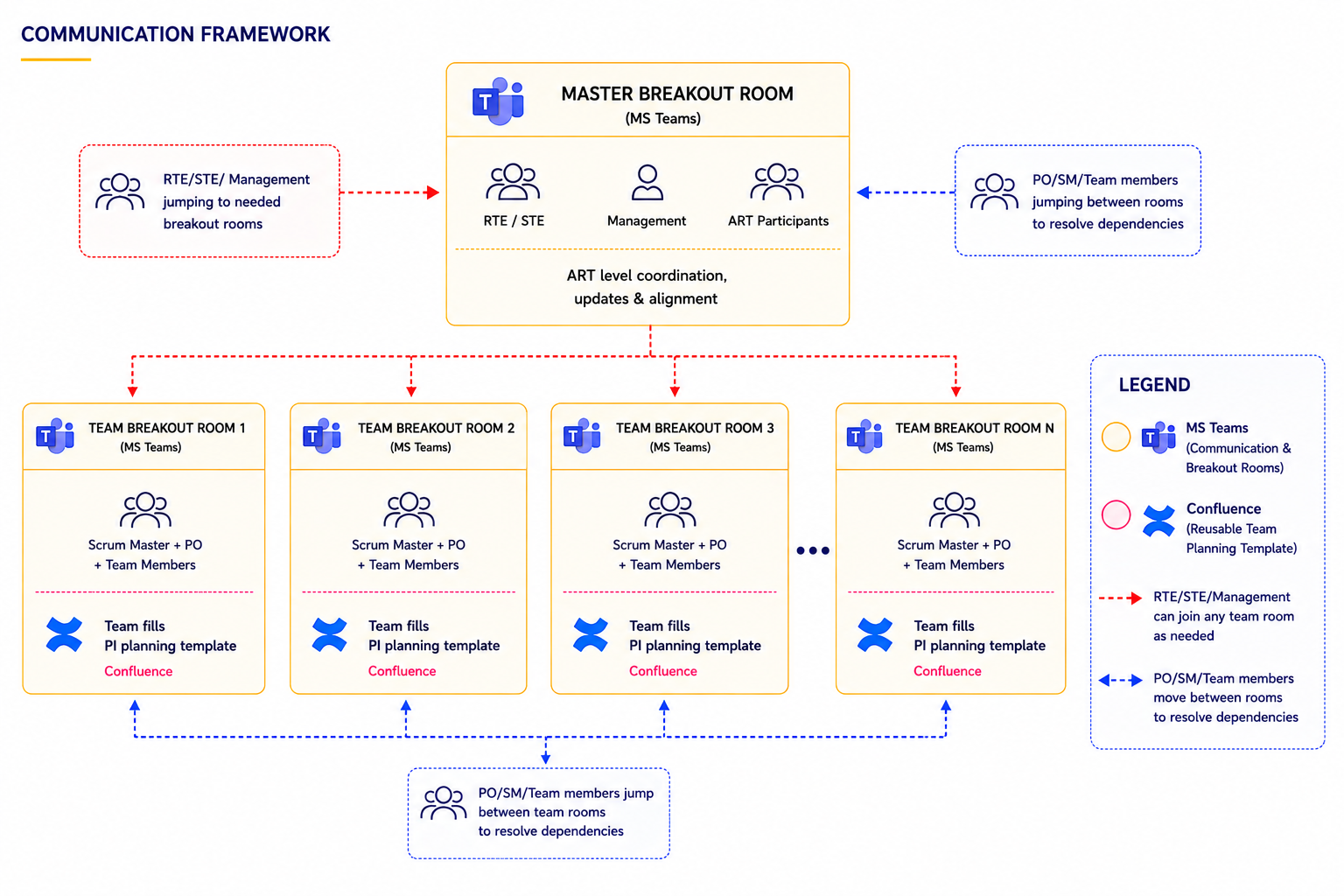
- The RTE and other management stakeholders moved dynamically between the different breakout rooms as needed to monitor planning progress.
- Product Owners and Scrum Masters performed their core team-level planning within their respective breakout rooms. However, they migrated to other rooms whenever direct clarifications or cross-team alignments were required.
- Participants were encouraged to enable their cameras whenever possible to maintain highly productive and engaging discussions throughout the event.
✅ Utilising separate team breakout rooms provided each team with a safe space to conduct focused planning while also keeping them connected to the rest of the ART.
- Overall PI Planning Event Schedule
The overall remote PI Planning event was structured around standard SAFe agenda items and supplemented with tailored alignments:
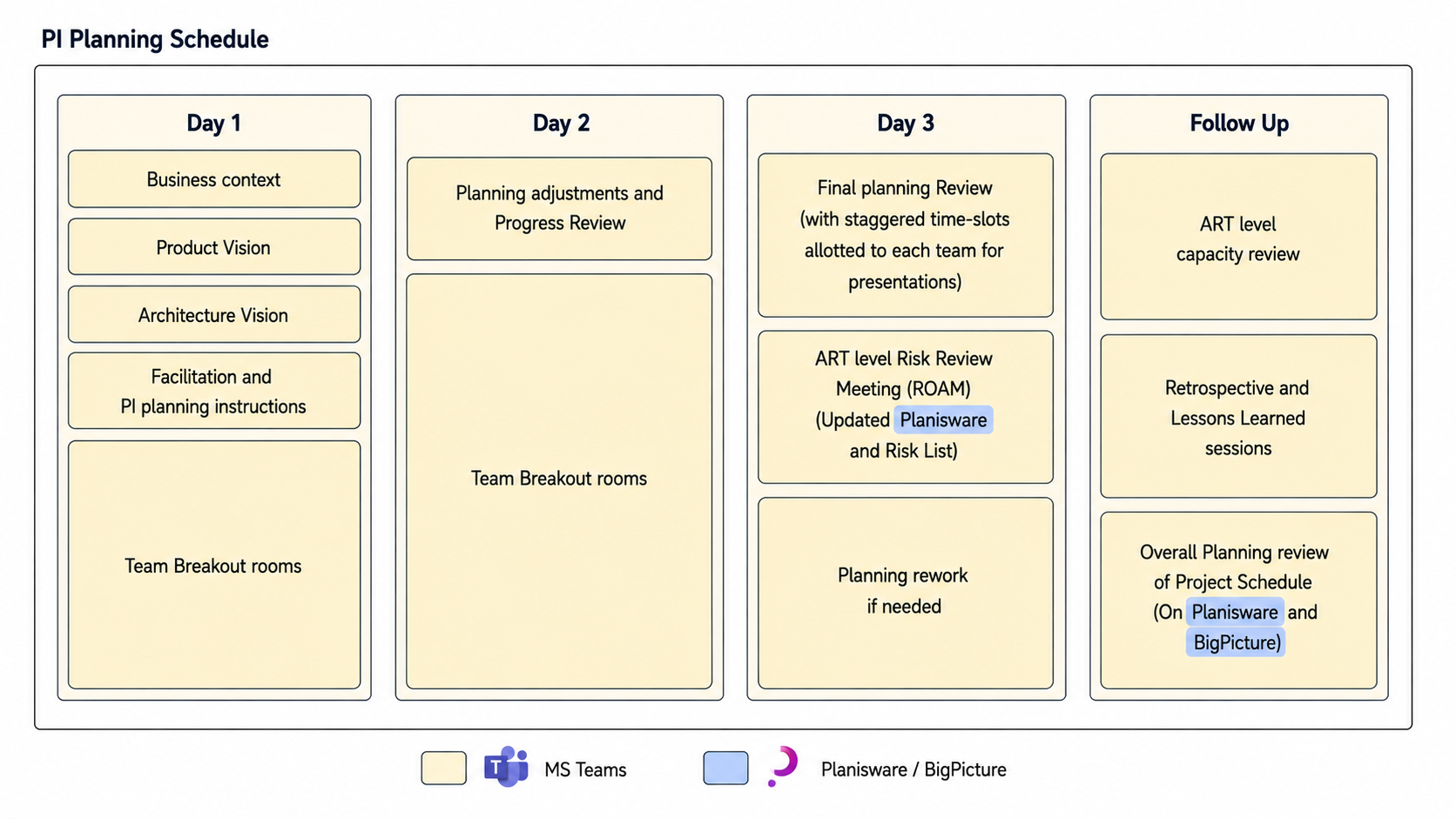
- A master meeting invitation tied to the Master Breakout Room was distributed train-wide. This channel was utilised exclusively for the Business Context, Product Vision, Architecture Vision, Facilitation Instructions, Progress Reviews, Final Reviews, Risk ROAMing, and all other ART-level dependencies.
- A separate meeting blocker containing the common list of team-specific room links was issued to manage the in-depth team planning blocks.
- A dedicated buffer day was integrated into Day 2, enabling distributed teams to plan at their own pace across different time zones while absorbing any technical or virtual delays.
- On Day 3, teams entered the final review session in predefined, staggered timeslots. This prevented the virtual master room from becoming overcrowded, ensuring every team had sufficient time to present their plan, highlight localized risks, and receive direct leadership feedback.
- A dedicated wrap-up block was scheduled following the main event to manage necessary plan reworks, final capacity reviews, and the event retrospective.
Overall Tool Landscape for the Remote PI Planning Event
As mentioned above, multiple tools were used to execute the remote PI planning framework. The complete tool landscape deployed for the event is summarized below:
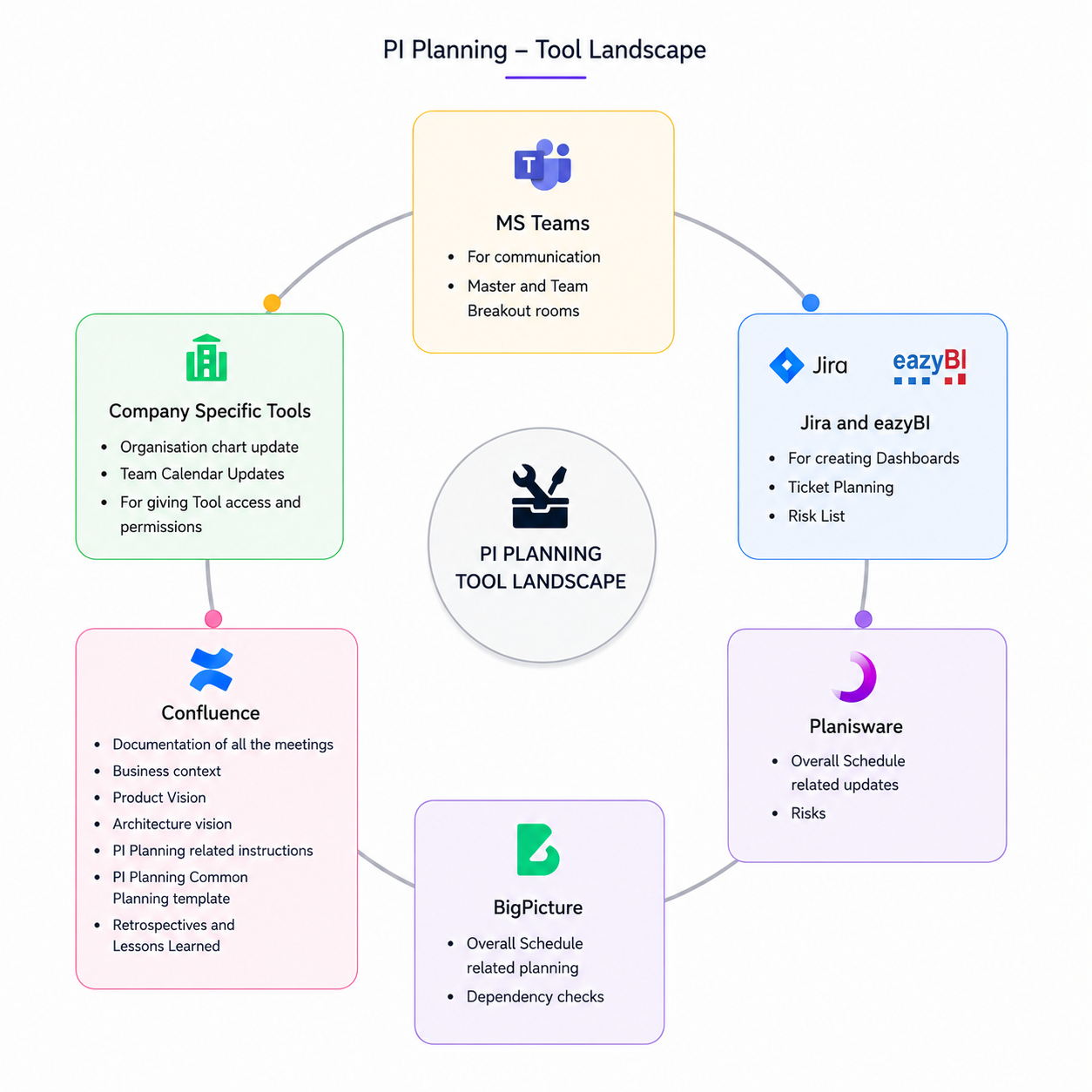
- The primary operational workflow was supported by Confluence, MS Teams, and Jira.
- Company-specific tools were used for team calendar updates and organisational charts to ensure accurate capacity calculations. Additionally, eazyBI was deployed to create reliable data dashboards, supporting the teams with real-time ticket planning and backlog hygiene.
- BigPicture and Planisware were utilised for train-wide risk documentation and to conduct high-level Gantt chart reviews of the overall ART schedule.
For the overall ART Schedule Gantt Chart review and risk documentation, BigPicture and Planisware shall be used.
This comprehensive toolkit established a sustainable, scalable and effective infrastructure for organising distributed PI Planning sessions.
⛳️ Expected Outcome and Results
By implementing the structured measures and utilising the compact toolkit defined in this framework, the remote event successfully secured the following outcomes:
- Established a consistent, results-oriented, and fully measurable Program Increment Planning process across the entire ART.
- Self-managing communication framework that ensured seamless cross-team coordination and drove deep ownership within each distributed team.
- Built a sustainable virtual planning infrastructure that functioned as a highly predictable funnel, surfacing all mandatory deliverables by the close of the event.
- Minimal facilitation overhead during the event, enabling the Release Train Engineer and Scrum Masters to monitor the train progress and unblock dependencies with ease.
💎 Project Artifacts
The execution of the remote framework generated and updated follow project artifacts:
- High-level ART objectives and core business needs are officially logged and accessible in Confluence.
- Updated ART Program Board which visualises feature delivery timelines, milestones and key dependencies
- Individual team-level planning pages
- Updated ART-level impediments and Risk lists which were further migrated to Planisware
- Updated Capacity planning and required resources secured for the Program Increment
- An updated project schedule on BigPicture and Planisware
- A compiled Retrospectives and Lessons Learned register to optimise future planning cycles.
- ART-wide Confidence Vote results that ensured commitment.
💡 Key Takeaways and Learnings
✅ The overall success of a remote PI Planning event relies heavily on ensuring psychological safety and establishing a robust communication framework tailored to globally distributed teams.
✅ A reliable technical infrastructure and a robust, integrated tool landscape are very critical for executing a seamless remote planning event.
✅ Thorough upfront preparation combined with a "fail-fast" mindset ensured that potential technical or logistical roadblocks were addressed early, allowing the event to run smoothly.
✅ Implementing the structured measures outlined in this case study successfully secured all mandatory work products by the close of the event, including:
➡️ Well-defined ART objectives and tangible team-level objectives
➡️ Fully documented and aligned program-level risks, impediments, and cross-team dependencies
➡️ Unified confidence votes collected and reviewed across the entire ART.
➡️ Comprehensively reviewed train-wide capacities, securing resource allocations for the upcoming increment
➡️ A highly valuable, structured Program Increment mapped out for the project
➡️ ART-Wide Backlog refined, cleaned up and prioritised
➡️ Actionable retrospective feedback and lessons learned to continuously optimize the team's way of working.
⏱️ Conclusion
As hybrid and remote work becomes the norm across most companies, it has become necessary to ensure that regular large-scale agile activities like PI Planning are not impacted. This case study explored the specific pain points of virtual planning and identified multiple structural measures that can be successfully combined to deliver a high-value remote PI Planning event.